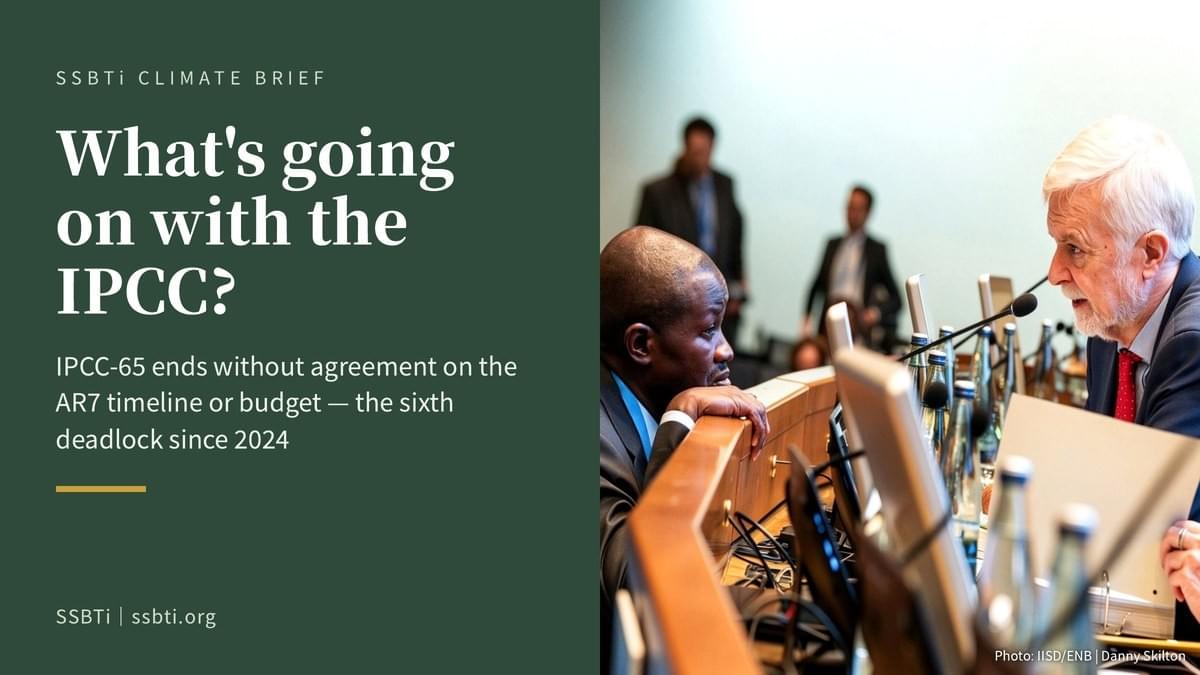
Key takeaways: The IPCC’s 65th plenary session (12–16 October 2026, Addis Ababa, Ethiopia) ended without agreement on either the timeline for the three Working Group contributions to the Seventh Assessment Report (AR7) or the budget to fund them. It was the sixth consecutive session since 2024 to fail on the timeline. IPCC Chair Jim Skea suspended, rather than closed, the session; a resumed session has been promised, but no date or venue has been announced. If contributions stay at 2025 levels, the IPCC Trust Fund is projected to run out by the end of 2028. For companies, the message is clear: updated climate science may arrive late, but the direction of decarbonization, and customer requirements, will not pause.
1. What happened at IPCC-65?
About 334 participants attended, including 225 Panel members representing 115 countries. Two items dominated the agenda, and neither was resolved:
- The AR7 timeline: when the three Working Group reports will be approved and published.
- The budget: funding for the rest of the AR7 cycle, starting with 2027.
Ahead of the meeting, the IPCC Secretariat set out three timeline options. Over five days, the number of options grew to seven before narrowing to four, including a proposal from Haiti for Working Group I approval in April 2028, Working Group II in July 2028 and Working Group III in October 2028. No option reached consensus.
On the final evening, with many delegates from developing countries already gone, Skea suspended the session so that no major decision would be taken in their absence. He described the outcome as a “profound disappointment”. He also reminded delegates that the scientific work itself continues: author teams are still writing.
2. Why does 2028 matter?
The global stocktake is the Paris Agreement’s five-yearly review of collective progress. It informs the next round of nationally determined contributions (NDCs) and climate finance. The second stocktake runs as follows:
- November 2026 (COP31): information collection begins.
- June 2027 – June 2028: technical assessment.
- November 2028 (COP33): political phase and conclusions.
To inform the second stocktake, AR7 needs to be published by the end of 2028. Skea had said a timeline would have to be agreed by the end of 2026 to make that possible, and IPCC-65 was the last plenary of 2026.
The stocktake asks how far we still have to go. The IPCC tells us where we need to be.
3. Six deadlocks in a row
The stocktake runs on a five-year cycle; IPCC assessment cycles typically take five to seven years (about eight between AR5 and AR6). AR6 informed the first stocktake because the schedules happened to line up, not because the two processes were formally aligned. The AR7 cycle formally began in July 2023 (IPCC-59, Nairobi). Since then, the timeline has stalled at every plenary:
- IPCC-60, Istanbul: no agreement.
- IPCC-61, Sofia: no agreement.
- IPCC-62, Hangzhou (February 2025): report outlines agreed; timeline still open.
- IPCC-63, Lima (October 2025): 2026 work plan agreed; full timeline still open.
- IPCC-64, Bangkok (March 2026): discussion focused on how to resolve the issue at IPCC-65.
- IPCC-65, Addis Ababa (October 2026): options narrowed from seven to four; no agreement.
Three positions emerged: publish AR7 before the 2028 stocktake, publish after it, or decouple AR7 from the stocktake altogether. Both main camps argue from fairness. One stresses that developing-country authors and governments need enough time to take part fully; the other, which includes many least developed countries and small island states, stresses that climate impacts will not wait for the science to catch up. The Earth Negotiations Bulletin noted that inclusivity dominated discussions throughout the meeting.
4. Even the meeting reports are stuck
The IPCC approves a written report after each plenary. The reports of the 61st to 64th sessions have still not been approved, so approving them was the first item on the IPCC-65 agenda. The disagreement reached as far as grammar: Belgium and Germany objected to heavy use of the passive voice, arguing it makes widely supported positions and minority views look equally weighted. A small group led by Vice-Chair Diana Ürge-Vorsatz reached a preliminary agreement on drafting principles, and the Secretariat will prepare revised drafts.
In other words, the dispute is no longer about the science. It is about whose objections get written down.
5. A trust fund with no buffer
The IPCC is funded by regular contributions from the World Meteorological Organization (WMO) and the UN Environment Programme (UNEP), plus voluntary contributions from member countries. Its largest historical donor, the United States, has not contributed since 2024 (it averaged about US$1.7 million a year under the previous administration). All figures below are in Swiss francs (CHF):
- Cost to complete AR7: about 33 million (roughly 8 million a year).
- Minimum annual contributions needed: 5.8 million, with no buffer for the unexpected.
- 2025: expenditure of 6.9 million against contributions of only 3.8 million.
- Cash balance: down from 17.8 million (1 January 2025) to 14.7 million (1 January 2026).
- 2026 contributions received: 2.8 million from 16 countries and organizations as of early July.
- If contributions stay at 2025 levels: the cash balance falls below the 5.0 million wind-down threshold in the second half of 2027 and is depleted by the end of 2028.
On the scale of global climate finance, these are very small sums. The gap left by the US could be covered by five or six governments contributing less than half a million dollars each. The problem is not the size of the money; it is that, like the timeline, the budget can only pass with the agreement of every country.
6. The final night: the budget is frozen too
Some delegations argued that without agreement on the timeline, there should be no budget, which held up funding even for activities already agreed. Skea proposed a 2027 budget almost identical to the indicative budget considered at IPCC-63, so the Working Groups could keep operating while talks continued. On the final evening he asked delegates to approve at least the 2026 and 2027 budgets. According to Carbon Brief, Saudi Arabia, India and Russia objected; the Democratic Republic of the Congo warned that the delay posed an immediate danger to the panel’s viability.
The IPCC has said it will reconvene at the earliest opportunity. Japan’s Ministry of the Environment confirmed on 22 October that the AR7 work plan and the 2027 budget will be taken up at a resumed IPCC-65 session, with dates to be announced by the Secretariat. Climate Analytics has called for the resumed session to be held this year, at least to agree the 2027 budget.
7. The structural problem: a procedural veto
The IPCC’s authority rests on two pillars: scientific credibility and government endorsement. It does not carry out original research; it organizes scientists to assess the published literature. Its Summaries for Policymakers are drafted by scientists and then approved line by line by governments together with the authors. Scientists make sure the findings are right; governments sign their names to them.
The price of that design is that every key decision requires consensus. Openly rejecting climate science is politically costly, and few governments do it. In the past, the contest played out over wording during report approval. Now it has moved upstream to three procedural levers:
- The timeline: the reports can still be written, but miss the stocktake and lose policy relevance.
- The budget: Working Groups, the Secretariat and developing-country participation are squeezed.
- The meeting record: objections are not clearly recorded, and accountability blurs.
None of these touch the findings themselves. They only control whether the findings arrive on time and with government endorsement. For any single government, this kind of procedural veto costs almost nothing. Consensus, once the IPCC’s greatest strength, has become its constraint, the same structural problem the UNFCCC negotiations have long faced.
8. Five takeaways for companies and supply chains
- Late science is not slower decarbonization. The emission pathways behind corporate 1.5°C science-based targets draw on scenarios already assessed by the IPCC. A delayed AR7 means updated baselines may arrive later; it does not invalidate the current ones. Companies that have set, or are setting, targets have no reason to pause.
- When international consensus stalls, markets and standards become the real anchors. Brand and retailer supplier requirements, CDP disclosure, product carbon footprints and EU regulation all move on their own timelines. None of them waits for the IPCC.
- Your own primary data is your most reliable asset. When science and policy timelines are uncertain, what a company controls is its own inventory, product footprint models and reduction record. The more robust and verifiable that data is, the less exposed the company is to outside schedules.
- Watch for a second adjustment after 2028. If AR7 is published after the stocktake, the stocktake’s conclusions will come first and the updated science later. National policies, and customer requirements, may then shift again.
- Treat process as a risk to manage. The IPCC’s situation is a reminder that in any multi-party system, progress is usually blocked by timelines, budgets and records rather than by conclusions. The same is true in supply chain decarbonization: decide early how data is collected, who signs off and how records are kept.
9. What to watch next
- Date and venue of the resumed IPCC-65: whether it happens in 2026 decides whether AR7 can still inform the 2028 stocktake.
- The 2027 budget: without it, the Working Groups and Secretariat will be constrained.
- New or increased contributions: whether the trust fund can stay above the wind-down threshold in 2027.
- The final timeline: which Working Group reports land before, and which after, the stocktake.
- The drafting principles for meeting reports: whether the preliminary agreement holds.
FAQ
What is AR7? The Seventh Assessment Report is the IPCC’s current assessment cycle, launched in July 2023. Its core is three Working Group reports, on the physical science, on impacts and adaptation, and on mitigation, followed by a synthesis report. The cycle also includes a Special Report on Climate Change and Cities and methodology reports.
Will AR7 miss the 2028 global stocktake? It has not been decided. It depends on whether the resumed IPCC-65 agrees a timeline, and a budget, soon enough for the reports to be approved by the end of 2028.
Does this change corporate science-based targets? Not directly. Existing targets rely on pathways the IPCC has already assessed. AR7 may eventually update those baselines, but the direction and urgency of decarbonization are unchanged.
Sources:
Carbon Brief, “Q&A: Why a pivotal IPCC meeting in Ethiopia ended in ‘profound disappointment’”: https://www.carbonbrief.org/qa-why-a-pivotal-ipcc-meeting-in-ethiopia-ended-in-profound-disappointment
Earth Negotiations Bulletin (IISD), IPCC-65 Summary report: https://enb.iisd.org/intergovernmental-panel-climate-change-ipcc-65-summary
IPCC, IPCC-LXIV/INF.12, Fundraising for the IPCC Trust Fund: https://apps.ipcc.ch/eventmanager/documents/97/180320261248-INF.%2012%20-%20Fundraising%20for%20TRF.pdf
Ministry of the Environment, Japan, results of IPCC-65 (22 October 2026): https://www.env.go.jp/press/press_05725.html
Lowy Institute, “IPCC funding crisis threatens Asia-Pacific”: https://www.lowyinstitute.org/the-interpreter/ipcc-funding-crisis-threatens-asia-pacific
Status as of 11 November 2026. Figures follow the original sources; budget figures are in Swiss francs.