

SSBTi briefing | Product data for supply-chain decisions. An organizational GHG inventory tells a company where its annual emissions arise. A product carbon footprint answers a different question: how much climate impact is associated with a defined product and life-cycle boundary? Manufacturers facing customer requests often need both views, plus reliable background datasets for materials, energy, transport and waste.
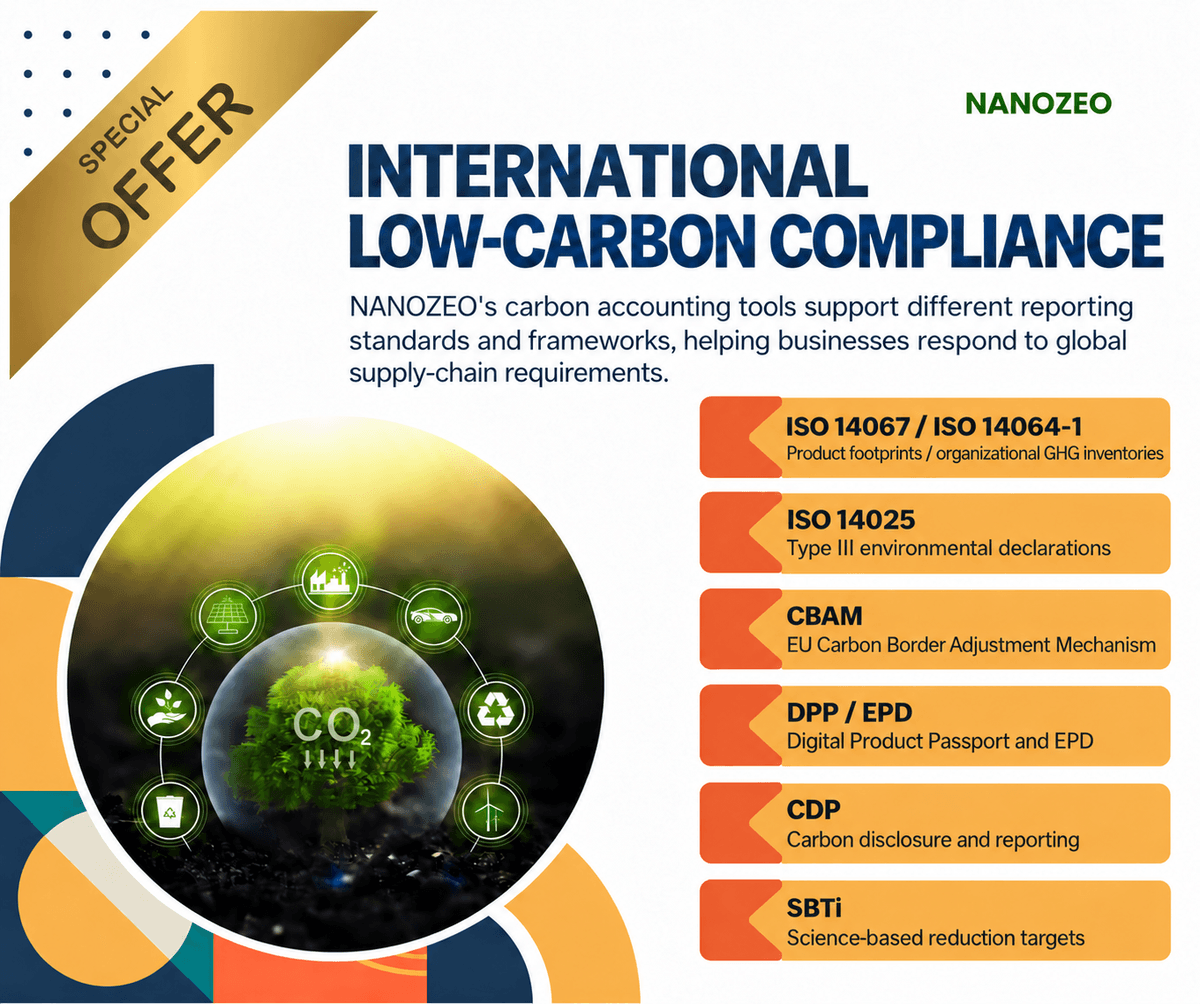
ISO 14064-1 addresses organization-level GHG inventories, while ISO 14067 addresses product carbon footprints. Company-wide electricity or fuel totals do not by themselves establish a product result. A product study needs a functional unit, system boundary, product-specific activity data, selected background datasets, calculations and documented assumptions. Product data may support customer supply-chain reporting, but its use in a Scope 3 inventory depends on that customer's method and boundary.
Why background datasets matter
ERP and purchasing records can show quantities, but many processes lack primary life-cycle data. A model therefore needs appropriate secondary data and transparent choices about geography, year, process, unit and allocation. Selecting a well-known database does not remove the need to justify each choice. A reviewer may also ask to inspect the model and the evidence behind its references.
NANOZEO's current 100-dataset offer
The NANOZEO product carbon footprint offer combines an Asia Edition model priced at NT$6,000 with an optional NT$18,000 international add-on. The combined price is NT$24,000; the add-on requires the base model. Licensed users can select up to 100 international ecoinvent datasets within a platform model, subject to the purchase terms. This is platform use, not a separate license to export the raw LCI dataset list. Check the purchase page and current conditions before ordering.
The platform authorization runs for one year. During that period, users can revise models under platform rules and generate downloadable coefficient reports for their records and use. The purchase page describes a 48-hour correction window after the first report output, followed by model lock. Teams should schedule model review before that first output.
A workflow for a report that can be reviewed
- Define the product and boundary. Set the functional unit, life-cycle stages, geography and intended use of the result.
- Collect activity data. Record materials, electricity, fuels, transport and waste with units, dates and evidence.
- Choose and document datasets. Confirm relevant processes and regions within the available database scope, and retain reasons for each choice.
- Review the model and output. Use the platform's revision period before locking the model; download available coefficient reports.
- Prepare third-party review. Work with a NANOZEO partner consultant or your own consultant to turn the calculations and references into a general product carbon footprint report. Keep platform access active during verification if the reviewer needs to inspect the model.
A platform-generated report is an input to the verification process, not verification itself. Acceptance and any carbon label are determined through the applicable program and verification body.
Common questions
Does a company GHG inventory replace a product footprint?
No. The boundaries and reporting units differ. Use the organizational inventory to understand company emissions and a product model to assess a defined product.
Are 100 datasets always enough?
That depends on the product model and the data it needs. List candidate processes and regions first, then check availability and suitability before purchasing.
Can a consultant use the model for verification preparation?
Yes. A partner consultant or your own consultant can use the calculations and citations in a general product carbon footprint report for third-party review. The verification body decides what evidence it will accept and inspect.
Read more and evaluate the offer
For the detailed comparison of product and organizational accounting, see the English NANOZEO digest. The NANOZEO English product update explains the platform terms and pricing. Review the current purchase terms if the model fits your workflow.
Editorial note, October 2026: This article is a principles-level explanation. The platform and coefficient-database development rules and requirements are governed by the terms in force at the time of license purchase.